In today’s world, where every watt counts, homeowners are constantly seeking ways to trim down their utility bills. Among the many appliances in our kitchens, the slow cooker often sparks a common question: does this countertop workhorse actually save electricity? The answer, for many, might be a delightful surprise. Far from being an energy hog, slow cookers stand out as one of the most energy-efficient cooking methods available, offering a blend of convenience and cost-effectiveness that’s hard to beat.
What is a Slow Cooker and How Does it Work?
A slow cooker, often affectionately called a Crock-Pot, is an electric cooking appliance that simmers food at a low temperature for an extended period. Its design is deceptively simple yet brilliantly effective: an outer pot typically made of metal, an inner stoneware or ceramic pot where the food cooks, and a tight-fitting lid. This trifecta creates a sealed environment that traps heat and moisture, allowing food to cook gently and evenly over several hours.
The principle behind slow cooking is all about low and slow heat. Unlike conventional ovens or stovetops that blast food with high temperatures, a slow cooker maintains a consistent, moderate heat. This method tenderizes tough cuts of meat, melds flavors beautifully, and ensures food is cooked through without burning. The primary components include the heating element at the base, the cooking insert, and a control dial for temperature settings like “low,” “high,” and “warm.” This steady, gentle heat is crucial to its energy-saving capabilities.
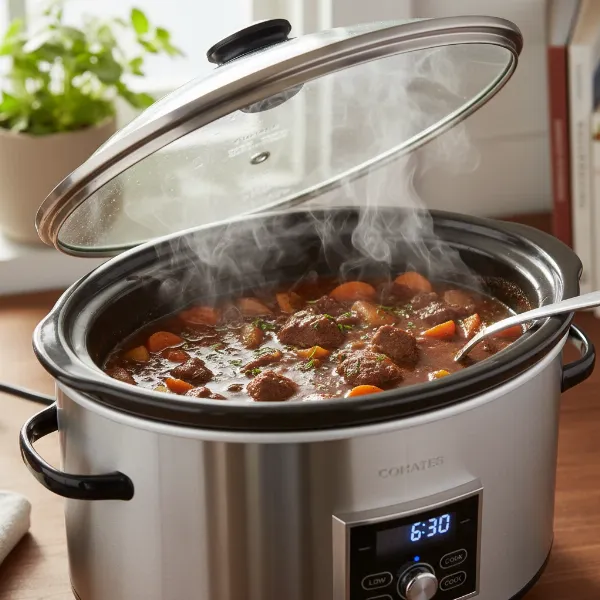 A close-up view of food gently simmering inside a modern slow cooker.
The Energy Consumption Question: Do Slow Cookers Really Save Electricity?
The fundamental question boils down to efficiency, and slow cookers genuinely excel in this area. While they operate for much longer durations than many other cooking appliances, their low wattage consumption makes them incredibly energy-efficient overall.
A typical slow cooker uses between 70 to 250 watts of electricity per hour, with many models hovering around 100 watts or less, especially on a low setting. To put this in perspective, this is comparable to the energy consumed by a standard light bulb. This low power draw is the core reason for their energy-saving potential.
Consider the energy needed to cook a meal: an electric oven can pull upwards of 2,000 to 5,000 watts, and even a microwave can use between 600 and 1,500 watts. While an oven cooks faster, it uses a massive burst of energy. A slow cooker, by contrast, sips electricity steadily over hours. For instance, an 8-hour slow cooker meal might consume around 0.7 kilowatt-hours (kWh) of electricity, whereas cooking the same meal in an oven for just one hour could use 2-2.2 kWh. This significant difference translates directly into lower electricity bills, proving that slow cookers are indeed a smart choice for energy-conscious households.
Comparing Slow Cookers to Other Kitchen Appliances
Understanding how slow cookers stack up against other common cooking methods highlights their efficiency.
Slow Cooker vs. Oven
|
Our Picks for the Best Slow cooker in 2026
As an Amazon Associate I earn from qualifying purchases.
|
||
| Num | Product | Action |
|---|---|---|
| 1 | Ninja MC1001 Foodi PossibleCooker PRO 8.5 Quart Multi-Cooker, with 8-in-1 Slow Cooker, Dutch Oven, Steamer, Glass Lid Integrated Spoon, Nonstick, Oven Safe Pot to 500°F, Sea Salt Gray |

|
| 2 | Ninja MC1101 Foodi Everyday Possible Cooker Pro, 8-in-1 Versatility, One-Pot Faster Cooking Replaces 10 Tools, Family-Sized Capacity with Adjustable Temp Control, 6.5 quarts, Midnight Blue |
|
| 3 | Crock-Pot 6 Quart Cook & Carry Programmable Slow Cooker with Digital Timer Stainless Steel (CPSCVC60LL-S) pack of 1 |
|
| 4 | Hamilton Beach 6-Quart Slow Cooker with 3 Cooking Settings, Dishwasher-Safe Stoneware Crock & Glass Lid, Silver (33665G) |
|
| 5 | Crock-Pot 6 Quart Programmable Slow Cooker with Timer and Auto Food Warmer Setting, Stainless Steel |
|
| 6 | Hamilton Beach Slow Cooker, Extra Large 10 Quart, Stay or Go Portable With Lid Lock, Dishwasher Safe Crock, Black (33195) |
|
| 7 | Crock-Pot 7 Quart Oval Manual Slow Cooker, Stainless Steel (SCV700-S-BR), Versatile Cookware for Large Families or Entertaining |
|
| 8 | Ninja® 12-in-1 PossibleCooker™ PLUS - 8.5-qt - Sous Vide & Proof Multi-Cooker - Slow Cooker, Dutch Oven & More - Glass Lid & Integrated Spoon - Nonstick - Oven Safe Pot to 500°F - Black - MC1010 |
|
| 9 | Crock-Pot Large 8-Quart Programmable Slow Cooker with Auto Warm Setting Black Stainless Steel |
|
| 10 | Slow Cooker 10-Quart - PFOA-Free Ceramic Coating, Oven Safe to 450°F - Keep Warm Function for Large Family Gatherings (Includes Silicone Spoon) |
|
This is where slow cookers truly shine. An oven requires a considerable amount of energy to preheat and then maintain a high temperature within a large, open cavity. Heat often escapes, and the overall wattage is substantially higher. For example, a six-quart slow cooker might operate at a maximum of 260 watts, costing about 5 cents per hour to run. Cooking a large cut of meat, like a pork shoulder, in an oven could cost upwards of $3.57 for 7 hours, while the same dish in a slow cooker for 8 hours might only cost around 40 cents. This makes slow cookers roughly 91% more energy-efficient than a full-size electric oven for certain dishes.
Slow Cooker vs. Stovetop
Stovetop cooking, especially using multiple burners or large pots, can consume a fair amount of energy. While induction cooktops are more efficient than traditional electric coil or gas burners, stovetop cooking still involves direct heat application and often more evaporation, requiring more energy to maintain temperature and cook food thoroughly. A slow cooker, with its sealed lid and insulated pot, minimizes heat loss and moisture escape, making it generally more efficient for long-simmering dishes.
Slow Cooker vs. Microwave
Microwaves are fast, but their energy usage per hour can be quite high (0.6 to 1.5 kWh). They are excellent for reheating or quick cooking of small items, but not suitable for the type of long, slow cooking that tenderizes meat and develops deep flavors. For extended cooking, a slow cooker is more energy-efficient than repeatedly using a microwave for a comparable meal.
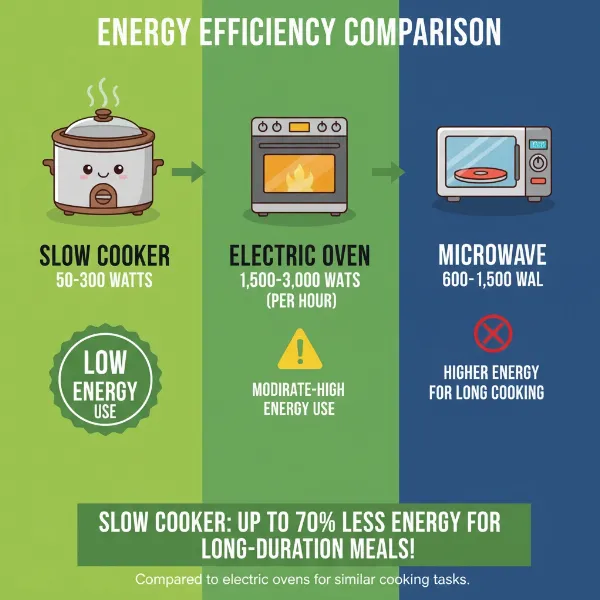 Infographic comparing the energy efficiency of various common kitchen cooking appliances.
Factors Influencing Slow Cooker Energy Usage
While slow cookers are inherently efficient, several factors can influence their actual electricity consumption.
Appliance Size and Capacity
Larger slow cookers typically have higher wattage ratings to heat a greater volume of food and a larger cooking insert. Choosing a slow cooker appropriate for your typical meal size is important. Using a large 7-quart slow cooker for a meal that only fills half its capacity is less efficient than using a smaller 3-quart model, as the larger appliance still needs to heat the entire internal space.
Temperature Settings and Cooking Duration
The “high” setting on a slow cooker uses more wattage than the “low” setting, naturally resulting in higher energy consumption over time. While the “high” setting cooks food faster, the “low” setting, despite its longer cooking time, often proves more energy-efficient for many recipes due to its significantly lower wattage draw. Longer cooking times at lower temperatures are generally more energy-efficient than shorter times at higher temperatures for the same dish.
Features and Technology
Modern slow cookers come with various features that can impact efficiency. Programmable models allow you to set specific cooking times and temperatures, ensuring the unit doesn’t run longer than necessary. Some models boast better insulation, further reducing heat loss and improving efficiency. Features like automatic “keep warm” settings use minimal power, but continuous use can add up.
Maximizing Energy Savings with Your Slow Cooker
To truly leverage the energy-saving potential of your slow cooker, consider these practical tips:
- Choose the Right Size: Match the slow cooker’s capacity to the quantity of food you’re preparing.
- Keep the Lid On: Every time you lift the lid, heat escapes, and the slow cooker has to work harder to regain its temperature, using more energy. Avoid peeking unless absolutely necessary.
- Utilize the “Low” Setting: Whenever possible, opt for the “low” setting. It’s generally more energy-efficient and often yields better flavor and texture for many dishes.
- Full to Two-Thirds Full: For optimal performance and energy efficiency, aim to fill your slow cooker at least halfway, but no more than two-thirds full.
- Pre-soak Beans: If cooking dried beans, pre-soaking them can reduce the required cooking time in the slow cooker, saving a little energy.
“Slow cookers are among the kitchen’s most energy-efficient appliances. Although they take longer to cook food, they’re rated at as little as 200 watts—less than a tenth of some electric ovens.” – Uswitch.com Energy Expert
Beyond Electricity Savings: Other Benefits of Slow Cooking
While energy efficiency is a compelling reason to embrace slow cooking, the advantages extend far beyond your electricity bill.
- Time-Saving Convenience: Prepare ingredients in the morning, set the slow cooker, and return home to a fully cooked meal. This hands-off approach is perfect for busy individuals and families.
- Flavor Enhancement: The long, slow cooking process allows flavors to meld and deepen in a way that quick cooking methods cannot achieve. Tough cuts of meat become incredibly tender and succulent.
- Nutrient Retention: The gentle heat helps preserve vitamins and minerals that might be lost with higher-temperature cooking.
- Cost-Effective Meals: Slow cookers excel at transforming inexpensive, tougher cuts of meat into delicious, melt-in-your-mouth dishes, helping you stretch your grocery budget.
- Reduced Kitchen Heat: During warmer months, using a slow cooker instead of an oven keeps your kitchen cooler, potentially reducing the need for air conditioning and saving even more energy.
Conclusion
In the debate over kitchen appliance energy consumption, slow cookers emerge as clear winners for many types of meals. Their inherently low wattage and sealed cooking environment make them remarkably energy-efficient compared to conventional ovens and stovetops, even when operating for extended periods. By understanding how they work and adopting best practices for their use, you can significantly reduce your electricity bills while enjoying delicious, wholesome meals with minimal effort.
Ready to make your kitchen more energy-efficient and your meal prep simpler? What will be the first energy-saving slow cooker recipe you try this week?
Frequently Asked Questions
How much electricity does a slow cooker use in 8 hours?
A typical slow cooker on a low setting might use around 0.7 kWh over 8 hours. The exact cost depends on your local electricity rates, but it’s generally one of the cheapest ways to cook a meal, often costing just a few cents per hour.
Is it cheaper to use a slow cooker than an oven?
Yes, for most slow-cooked dishes, it is significantly cheaper to use a slow cooker than an oven. Ovens draw much higher wattage to heat a larger space, while slow cookers use minimal power over a longer duration, resulting in lower overall electricity consumption and cost for a comparable meal.
Do slow cookers consume a lot of energy on the “warm” setting?
No, the “warm” setting on a slow cooker consumes very little energy. It’s designed to maintain the food’s temperature safely after cooking is complete, typically using less power than even the “low” cooking setting.
Can using a slow cooker help reduce my carbon footprint?
By using less electricity compared to other cooking methods for certain meals, slow cookers can contribute to reducing your household’s overall energy consumption, which in turn can help lower your carbon footprint, especially if your electricity comes from fossil fuel sources.