Embarking on a journey into slow-cooked meals can be incredibly rewarding, offering tender textures and deep, rich flavors with minimal fuss. Yet, the terms “braising” and “slow cooking” are often used interchangeably, leading to confusion among home chefs. While both methods involve cooking food gently over an extended period, they possess distinct characteristics in technique, liquid use, and resulting flavor profiles. Understanding these nuances is key to mastering each approach and achieving the perfect dish every time. Let’s delve into the fundamental differences and discover when to choose one method over the other to elevate your culinary creations.
What is Braising?
Braising is a classic cooking technique that combines both moist and dry heat to transform tough cuts of meat and hearty vegetables into incredibly tender, flavorful dishes. The process typically begins with searing the food, usually meat, at a high temperature to develop a rich brown crust and complex flavors through the Maillard reaction. After searing, the food is partially submerged in a flavorful liquid—such as broth, wine, or stock—within a heavy, lidded pot like a Dutch oven. It then cooks slowly at a low temperature, either on the stovetop or in the oven, allowing the connective tissues in the meat to break down gradually, resulting in a fall-apart tender texture and a deeply concentrated sauce. The key is the partial submersion, where the food is cooked by both the simmering liquid and the steam trapped within the covered pot.
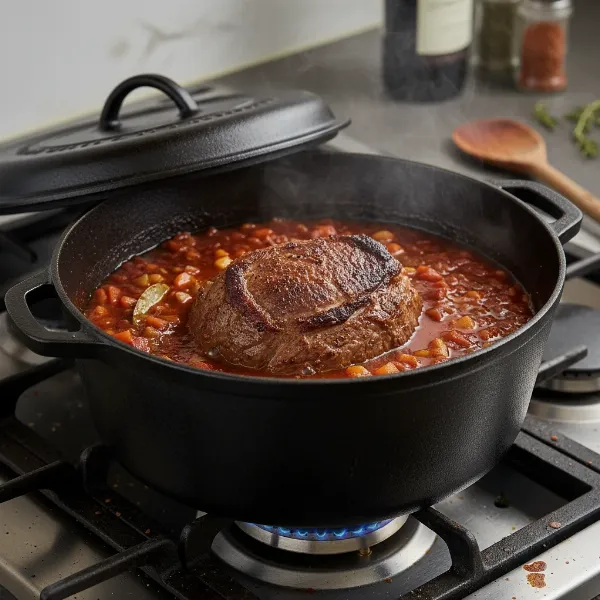 Seared meat partially submerged in liquid in a Dutch oven for braising.
What is Slow Cooking?
Slow cooking, often performed in a dedicated slow cooker appliance (or Crock-Pot), is a predominantly moist-heat cooking method designed for convenience and consistent, low-temperature cooking over many hours. Unlike braising, slow cooking usually involves submerging the food, or at least a significant portion of it, in a liquid from the outset, allowing it to simmer gently throughout the cooking period. The appliance maintains a steady, low heat, providing a hands-off approach that’s ideal for busy schedules. The goal of slow cooking is to tenderize food and meld flavors uniformly, often creating comforting stews, chilis, and pot roasts that are ready to eat at the end of a long day with minimal supervision.
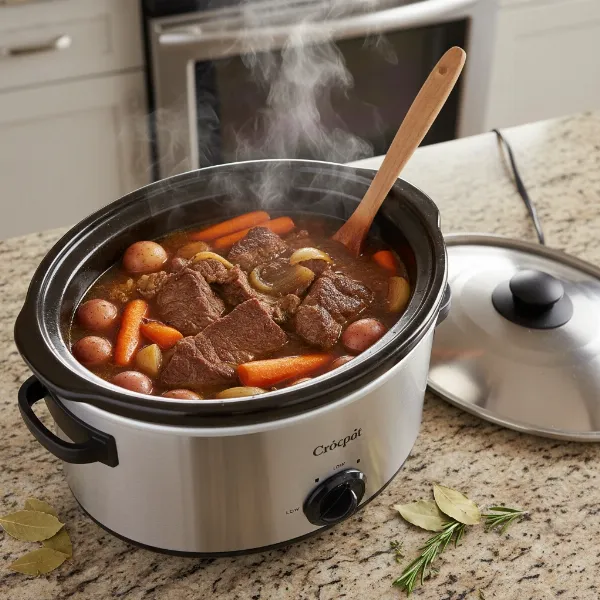 A slow cooker filled with a pot roast and vegetables, fully submerged in broth.
Key Differences: Braising vs. Slow Cooking
While both techniques aim for tender, flavorful results through prolonged, low-heat cooking, their methodologies diverge in several critical areas.
The Role of Liquid: Amount and Submersion
|
Our Picks for the Best Slow cooker in 2026
As an Amazon Associate I earn from qualifying purchases.
|
||
| Num | Product | Action |
|---|---|---|
| 1 | Crock-Pot 6 Quart Cook & Carry Programmable Slow Cooker with Digital Timer Stainless Steel (CPSCVC60LL-S) pack of 1 |

|
| 2 | Ninja MC1001 Foodi PossibleCooker PRO 8.5 Quart Multi-Cooker, with 8-in-1 Slow Cooker, Dutch Oven, Steamer, Glass Lid Integrated Spoon, Nonstick, Oven Safe Pot to 500°F, Sea Salt Gray |
|
| 3 | Slow Cooker 10-Quart - PFOA-Free Ceramic Coating, Oven Safe to 450°F - Keep Warm Function for Large Family Gatherings (Includes Silicone Spoon) |
|
| 4 | Crock-Pot Large 8-Quart Programmable Slow Cooker with Auto Warm Setting Black Stainless Steel |
|
| 5 | Ninja® 12-in-1 PossibleCooker™ PLUS - 8.5-qt - Sous Vide & Proof Multi-Cooker - Slow Cooker, Dutch Oven & More - Glass Lid & Integrated Spoon - Nonstick - Oven Safe Pot to 500°F - Black - MC1010 |
|
| 6 | Crock-Pot 6 Quart Programmable Slow Cooker with Timer and Auto Food Warmer Setting, Stainless Steel |
|
| 7 | Hamilton Beach 6-Quart Slow Cooker with 3 Cooking Settings, Dishwasher-Safe Stoneware Crock & Glass Lid, Silver (33665G) |
|
| 8 | Ninja MC1101 Foodi Everyday Possible Cooker Pro, 8-in-1 Versatility, One-Pot Faster Cooking Replaces 10 Tools, Family-Sized Capacity with Adjustable Temp Control, 6.5 quarts, Midnight Blue |
|
| 9 | Crock-Pot 7 Quart Oval Manual Slow Cooker, Stainless Steel (SCV700-S-BR), Versatile Cookware for Large Families or Entertaining |
|
| 10 | Hamilton Beach Slow Cooker, Extra Large 10 Quart, Stay or Go Portable With Lid Lock, Dishwasher Safe Crock, Black (33195) |
|
One of the most significant distinctions lies in the amount of cooking liquid used. In braising, the food is only partially submerged, typically about one-third to halfway up the side of the main ingredient. This allows the top portion of the food to be cooked by steam, while the submerged part benefits from the simmering liquid, contributing to a rich, concentrated sauce as it reduces. Conversely, slow cooking often calls for the food to be fully or mostly submerged in liquid. This ensures consistent moist heat distribution throughout the entire cooking process, keeping ingredients from drying out over extended periods.
Initial Searing: Flavor Development
Braising almost invariably begins with a crucial searing step, where meat is browned vigorously in fat before any liquid is added. This high-heat browning creates a caramelized crust, developing deep, complex flavors that are fundamental to the final dish. The fond (browned bits) left in the pan after searing are then deglazed, incorporating those intense flavors into the cooking liquid. While searing is highly recommended for slow cooking to enhance flavor, it is not always a mandatory step, especially in recipes focused on ultimate convenience. Many slow cooker recipes simply combine all ingredients uncooked, relying on the long cooking time to develop flavors, though often with a less profound depth than braised dishes.
Cooking Vessels and Heat Source
Traditionally, braising is performed in a heavy, oven-safe pot, most commonly a Dutch oven. This allows for searing on the stovetop and then transferring the pot to an oven for the slow, moist-heat cooking phase. The oven provides even heat distribution around the entire pot, promoting gentle, consistent cooking. Slow cooking, as the name suggests, primarily utilizes a dedicated slow cooker appliance. These electric devices feature a ceramic or stoneware insert within a heating unit, providing steady, low heat for extended periods without requiring an oven or constant monitoring.
Temperature and Time
Both methods involve low temperatures and long cooking times, but there can be subtle differences. Braising temperatures in an oven typically range from 275°F to 325°F (135°C to 160°C). The initial sear often occurs at much higher temperatures. Slow cookers operate at even lower, more consistent temperatures, usually around 170°F to 280°F (77°C to 138°C) on their “low” and “high” settings, respectively. The consistent, controlled heat of a slow cooker is specifically designed for unattended cooking for many hours, making it ideal for set-it-and-forget-it meals.
Culinary Goals and End Results
The primary goal of braising is often to achieve both incredibly tender food and a highly concentrated, rich, and often glossy sauce derived from the reduced cooking liquid and fond. The searing step contributes significantly to this flavor depth and color. Slow cooking, while also producing tender food, often prioritizes convenience and creating comforting, deeply flavored meals where the liquid might be more abundant and less intensely reduced. While a slow cooker can produce delicious sauces, they may require additional reduction after cooking if a thicker consistency is desired.
When to Braise vs. When to Slow Cook
Choosing between braising and slow cooking depends on your desired outcome, available time, and the specific dish you’re preparing.
Ideal Dishes for Braising
Braising shines with tougher cuts of meat rich in connective tissue, such as:
- Beef short ribs
- Chuck roast
- Lamb shanks
- Pork shoulder or butt
- Oxtail
It’s also excellent for robust vegetables like cabbage wedges or root vegetables that benefit from deep flavor infusion and tenderization. Braising is perfect when you want a dish with incredible depth of flavor, a rich, reduced sauce, and are willing to invest a bit more active time in the initial searing process.
Ideal Dishes for Slow Cooking
Slow cooking is the ultimate solution for busy home cooks who desire hands-off meal preparation. It’s perfectly suited for:
- Chilis and stews
- Pot roasts (often with vegetables added directly)
- Pulled pork or chicken for sandwiches
- Soups and broths
- Baked potatoes or even some desserts
This method excels when you need a meal to cook unattended for many hours, providing convenience and a consistently tender result, even if it means sacrificing some of the intense, seared flavors that characterize traditional braising.
Can a Slow Cooker Be Used for Braising?
The question of whether a slow cooker can be used for braising often arises. While a slow cooker can certainly create tender, moist results by cooking food in liquid at a low temperature, it technically cannot replicate traditional braising entirely. The key missing element is the initial high-heat searing and the even, all-around heat of an oven.
However, you can adapt braising recipes for a slow cooker by performing the searing step separately on the stovetop in a pan or a Dutch oven. Sear your meat, deglaze the pan, and then transfer the seared meat and flavorful liquid to your slow cooker to complete the long, gentle cooking. This hybrid approach allows you to achieve many of the flavor benefits of braising with the convenience of a slow cooker.
Expert Tips for Mastering Low and Slow Cooking
Whether you’re braising in a Dutch oven or slow cooking in an appliance, these expert tips will help you achieve outstanding results.
Choosing the Right Cuts of Meat
For both methods, select tougher, fattier cuts of meat with plenty of connective tissue. These cuts, often less expensive, become incredibly tender and flavorful with long, slow cooking, as the collagen breaks down into gelatin. Think chuck, brisket, short ribs, and pork shoulder.
Layering Flavors
Don’t skip building layers of flavor. For braising, this starts with searing the meat. For both methods, sautéing aromatics like onions, garlic, and carrots before adding them to the pot can deepen the taste. Deglazing the pan after searing is crucial for capturing all those delicious browned bits.
Adjusting Liquid
For braising, remember to only partially submerge the main ingredient; too much liquid will result in boiling rather than braising. For slow cooking, if a recipe calls for a specific liquid amount, stick to it. If adapting, consider that slow cookers lose very little moisture due to their tight-fitting lids, so you may need less liquid than a conventional stovetop or oven recipe.
Braising vs. Slow Cooking: A Quick Comparison Table
| Feature | Braising | Slow Cooking |
|---|---|---|
| Definition | Searing + cooking partially submerged in liquid at low temp. | Cooking fully/mostly submerged in liquid at low, consistent temp. |
| Liquid Level | Partially submerges food (1/3 – 1/2 way up) | Fully or mostly submerges food |
| Initial Step | Mandatory high-heat searing for browning | Optional (but recommended for flavor) |
| Equipment | Dutch oven, oven-safe pot, oven | Electric slow cooker appliance |
| Heat Type | Combination of dry (sear) & moist (liquid+steam) | Primarily moist heat |
| Primary Goal | Tender food, rich reduced sauce | Tender food, convenience, hands-off cooking |
| Typical Dishes | Beef Bourguignon, Coq au Vin, Pot Roast | Chili, Pulled Pork, Stews, Soups |
Conclusion
Understanding the difference between braising and slow cooking empowers you to choose the perfect technique for your culinary ambitions. While both deliver incredibly tender, flavorful results through gentle, prolonged heat, braising offers a unique depth of flavor through its initial searing and partial liquid submersion, yielding rich, concentrated sauces. Slow cooking, on the other hand, prioritizes convenience and a consistent, hands-off approach, making it ideal for busy lifestyles. Each method has its distinct strengths, offering diverse paths to delicious, comforting meals.
Which technique will you master first to transform your kitchen into a haven of aromatic delights?
Frequently Asked Questions
Can I sear meat in a slow cooker?
Most standard slow cookers do not have a searing function. To sear meat for a slow cooker recipe, you typically need to do it in a separate pan on the stovetop before transferring it to the slow cooker insert. Some newer, multi-functional slow cookers or electric pressure cookers might offer a “sauté” or “brown” setting that allows for searing in the same pot.
Is braising healthier than slow cooking?
Neither braising nor slow cooking is inherently “healthier” than the other; the healthfulness of a dish depends on the ingredients used. Both methods are excellent for tenderizing leaner, tougher cuts of meat, which can be part of a healthy diet. The advantage is that they often require less added fat compared to other cooking methods.
What kind of lid is best for braising?
For braising, a heavy, tight-fitting lid is essential to trap steam and moisture inside the pot, which helps tenderize the food and prevent excessive evaporation of the cooking liquid. Dutch ovens typically come with such lids, making them ideal for the braising process.