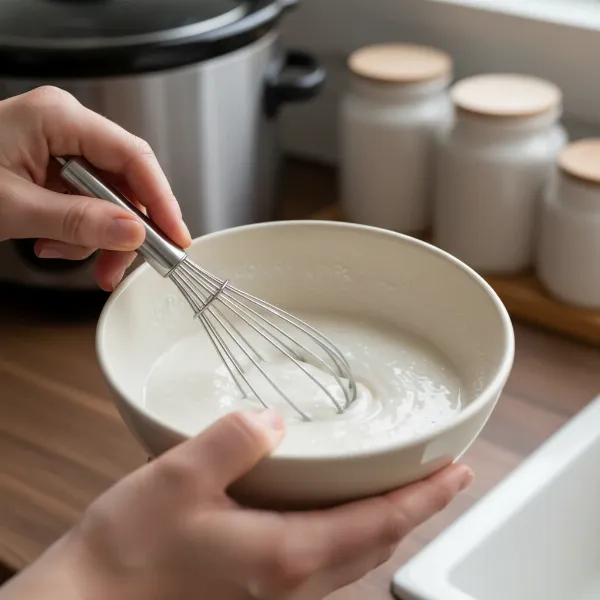
Are you seeking a culinary companion that simplifies meal preparation while delivering delicious, wholesome dishes? Slow cookers have revolutionized home cooking, offering unmatched convenience and flavor. But for the discerning chef, knowing the origin of your kitchen appliances matters. In an era of globalized manufacturing, finding slow cookers genuinely crafted in the USA or Europe ensures adherence to specific quality standards, ethical production, and often, innovative design. This article delves into the world of slow cooking, spotlighting exceptional models from the US and European markets that stand out for their craftsmanship and performance.
What is a Slow Cooker?
A slow cooker, often referred to by the brand name Crock-Pot, is an electric cooking appliance designed to simmer food at a low temperature for several hours. Its fundamental principle is straightforward: gentle, consistent heat over an extended period. This method allows flavors to meld beautifully, tenderizes tough cuts of meat, and preserves nutrients that might be lost with faster cooking methods.
Typically, a slow cooker consists of a few main components: an outer housing (usually metal) that contains a heating element, a removable inner pot (often ceramic or stoneware), and a lid (usually glass). The heating element warms the inner pot evenly, while the heavy lid traps moisture and heat, creating a self-basting environment. The concept of slow cooking has ancient roots, drawing from methods like pit cooking or haybox cooking, but the modern electric slow cooker gained popularity in the mid-20th century as a boon for busy households.
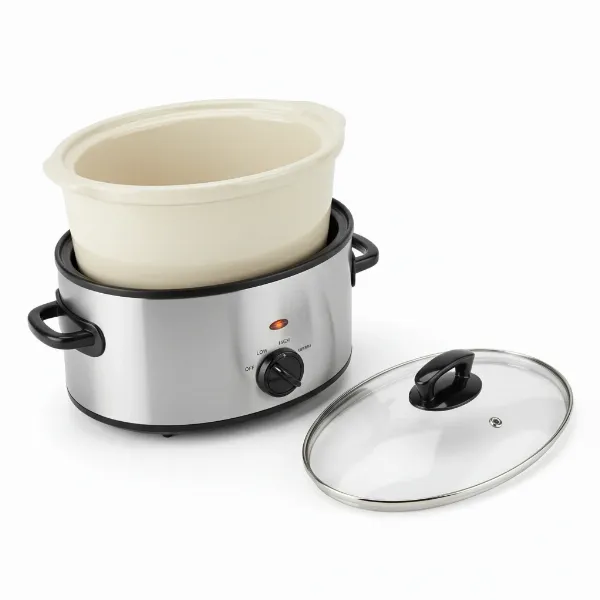 classic electric slow cooker with removable ceramic pot and glass lid, showing components
The Remarkable Benefits of Using a Slow Cooker
Incorporating a slow cooker into your kitchen arsenal offers a multitude of advantages that go beyond just convenience:
- Time and Effort Savings: Perhaps the most celebrated benefit is the “set it and forget it” nature. With minimal morning prep, you can leave ingredients to simmer all day, returning home to a ready-to-eat meal. This dramatically reduces active cooking time during busy evenings.
- Nutrient Retention and Enhanced Flavor: The low-temperature cooking process helps to preserve delicate vitamins and minerals that can be degraded by high heat. Moreover, slow simmering allows ingredients to fully develop and integrate their flavors, resulting in richer, more complex dishes.
- Versatile Meal Preparation: From hearty stews, tender roasts, and savory soups to baked goods, dips, and even desserts, a slow cooker can handle an astonishing array of recipes. Many multi-cookers now include dedicated slow cook functions, expanding possibilities further.
- Safety and Ease of Use: Modern slow cookers are designed with safety in mind, featuring insulated exteriors and automatic shut-off or keep-warm functions. Their simple controls make them accessible even for novice cooks.
- Energy Efficiency: While they cook for longer periods, slow cookers generally consume less electricity than a conventional oven, making them a more energy-efficient choice for extended cooking tasks.
Categorizing Slow Cookers on the Market
Slow cookers come in various forms, each offering distinct advantages. Understanding these classifications can help you choose the best fit for your culinary style.
By Design
|
Our Picks for the Best Slow cooker in 2026
As an Amazon Associate I earn from qualifying purchases.
|
||
| Num | Product | Action |
|---|---|---|
| 1 | Crock-Pot 7 Quart Oval Manual Slow Cooker, Stainless Steel (SCV700-S-BR), Versatile Cookware for Large Families or Entertaining |

|
| 2 | Slow Cooker 10-Quart - PFOA-Free Ceramic Coating, Oven Safe to 450°F - Keep Warm Function for Large Family Gatherings (Includes Silicone Spoon) |
|
| 3 | Crock-Pot Large 8-Quart Programmable Slow Cooker with Auto Warm Setting Black Stainless Steel |
|
| 4 | Ninja® 12-in-1 PossibleCooker™ PLUS - 8.5-qt - Sous Vide & Proof Multi-Cooker - Slow Cooker, Dutch Oven & More - Glass Lid & Integrated Spoon - Nonstick - Oven Safe Pot to 500°F - Black - MC1010 |
|
| 5 | Hamilton Beach 6-Quart Slow Cooker with 3 Cooking Settings, Dishwasher-Safe Stoneware Crock & Glass Lid, Silver (33665G) |
|
| 6 | Crock-Pot 6 Quart Programmable Slow Cooker with Timer and Auto Food Warmer Setting, Stainless Steel |
|
| 7 | Crock-Pot 6 Quart Cook & Carry Programmable Slow Cooker with Digital Timer Stainless Steel (CPSCVC60LL-S) pack of 1 |
|
| 8 | Ninja MC1101 Foodi Everyday Possible Cooker Pro, 8-in-1 Versatility, One-Pot Faster Cooking Replaces 10 Tools, Family-Sized Capacity with Adjustable Temp Control, 6.5 quarts, Midnight Blue |
|
| 9 | Hamilton Beach Slow Cooker, Extra Large 10 Quart, Stay or Go Portable With Lid Lock, Dishwasher Safe Crock, Black (33195) |
|
| 10 | Ninja MC1001 Foodi PossibleCooker PRO 8.5 Quart Multi-Cooker, with 8-in-1 Slow Cooker, Dutch Oven, Steamer, Glass Lid Integrated Spoon, Nonstick, Oven Safe Pot to 500°F, Sea Salt Gray |
|
Traditional electric slow cookers are standalone appliances with an integrated heating base. Multi-cookers, on the other hand, combine several cooking functions (pressure cooking, searing, slow cooking) into one unit, offering greater versatility. There are also traditional slow cooking pots, such as ceramic or cast iron vessels, designed for use on a stovetop or in an oven.
By Capacity
Slow cooker capacities typically range from small (1.5-3 quarts for 1-2 people), to medium (4-6 quarts for 3-5 people), and large (6.5 quarts or more for families or entertaining).
By Pot Material
The inner pot material significantly influences performance and durability. Common materials include:
- Ceramic/Stoneware: Excellent at retaining and distributing heat evenly, often removable and dishwasher-safe.
- Stainless Steel: Durable, sometimes stovetop-safe for browning ingredients before slow cooking.
- Cast Iron: Exceptional heat retention and distribution, ideal for traditional slow cooking in an oven or on a stovetop, though heavier.
- Pure Clay: A traditional, non-toxic option that offers unique cooking properties, often for stovetop or oven use.
By Features
Slow cookers can be broadly categorized by their control mechanisms:
- Manual: Simple “High,” “Low,” and “Warm” settings.
- Programmable: Allow you to set specific cooking times, after which they often automatically switch to a “Warm” setting.
- Digital/Smart: Offer advanced features like digital displays, delay timers, temperature probes, and even smartphone connectivity.
- Multi-functional: As mentioned, these appliances combine slow cooking with other modes like pressure cooking, searing, or steaming.
Choosing the Right Slow Cooker for Your Home
Selecting the perfect slow cooker requires considering your individual cooking habits, household size, and desired features.
Assess Your Needs
Before diving into models, consider how you’ll primarily use your slow cooker. Are you batch cooking for a large family, preparing meals for one or two, or seeking a versatile appliance for diverse culinary tasks? This initial assessment will guide your decisions on capacity and features.
Consider Capacity
For individuals or couples, a 1.5 to 3-quart model might suffice. A 4 to 6-quart slow cooker is ideal for small to medium families, while 6.5 quarts or larger is suitable for entertaining or making larger quantities of food for meal prepping.
Prioritize Pot Material & Safety
Look for durable, non-toxic materials. Ceramic and stoneware are popular for even heating. If opting for non-stick, ensure it’s free from harmful chemicals like PFAS and PFOA. Removable, dishwasher-safe inserts simplify cleanup.
Evaluate Features
Decide if you need basic manual settings or advanced programmability, a digital timer, or a temperature probe. Multi-cookers offer incredible versatility if you want to consolidate appliances, but a dedicated slow cooker might be simpler for specific needs.
Brand Reputation & Manufacturing Origin
For those prioritizing quality and ethical production, focus on brands with a strong reputation for craftsmanship. As this article highlights, models “Made in USA or Europe” often signify stringent quality controls and sometimes more sustainable practices. Research a brand’s specific manufacturing claims, as some may only assemble products locally while sourcing components globally.
Price vs. Value
Prices vary widely. While budget-friendly options exist, investing in a higher-quality slow cooker or multi-cooker from a reputable manufacturer, especially one made in the USA or Europe, often translates to better performance, durability, and a longer lifespan.
Top 5 Slow Cookers Made in USA or Europe
Finding electric slow cookers genuinely manufactured entirely in the USA or Europe can be challenging, as many major brands globalize production. However, by looking at both traditional methods and innovative multi-cookers from reputable brands, we can identify excellent options that adhere to the “Made in USA or Europe” criteria.
1. Miriams Earthen Cookware (USA)
For those who prefer a traditional, non-electric approach to slow cooking, Miriams Earthen Cookware offers a unique and healthy option. These pure primary clay pots are handcrafted in Dedham, Massachusetts, USA, using US-sourced clay. Designed for stovetop or oven use, they replicate ancient slow cooking methods, providing gentle, even heat distribution. Their non-toxic nature, free from metals, glazes, and non-stick coatings, appeals to health-conscious cooks. While not an electric appliance, they embody the essence of slow cooking with deep flavor development.
2. Thermomix by Vorwerk (Germany & France)
The Thermomix, developed by the renowned German company Vorwerk, is a high-end multi-functional kitchen appliance with robust slow cooking capabilities. Its components, including the motor and mixing blades, are manufactured in Wuppertal-Laaken, Germany, with final assembly for models like the TM7 taking place in France. This appliance excels at precise temperature control and offers a “guided cooking” experience that includes numerous slow cooker recipes. It’s an all-in-one solution for those seeking European engineering and versatility.
3. Magimix Cook Expert (France)
Another stellar multi-functional appliance with a strong slow cooking feature is the Magimix Cook Expert, originating from France. This sophisticated kitchen machine combines a food processor, blender, steamer, and more, including a dedicated slow cook program. Magimix is celebrated for its robust construction and high-quality engineering, with products typically made in France. The Cook Expert offers precise temperature control and a “Simmer & Stir” function, making hands-free slow cooking effortless and ensuring consistently tender, flavorful results. They also offer a Cocotte slow cooker accessory, further enhancing its slow cooking capabilities.
4. Fissler Vitavit Premium Pressure Cooker (Germany)
While primarily known as a pressure cooker, Fissler’s Vitavit Premium series from Germany offers multi-functional capabilities, including effective slow cooking. Designed, developed, and manufactured in Germany, Fissler products are synonymous with precision engineering and durability. Their pressure cookers are crafted from high-quality stainless steel and are built to exacting standards. Many modern pressure cookers feature settings that allow for low-temperature simmering, effectively turning them into a versatile slow cooking tool, leveraging Fissler’s renowned German craftsmanship.
5. Le Creuset Cast Iron Dutch Oven (France)
For those who appreciate the enduring quality of traditional cookware for slow cooking, a Le Creuset Cast Iron Dutch Oven is an iconic choice. These premium enameled cast iron pots are famously made in France and are exceptional for slow cooking on the stovetop or in the oven. Their superior heat retention and distribution create a consistent, gentle cooking environment, perfect for braises, stews, and roasts. While not an electric appliance, it’s a testament to European artisanal quality and provides outstanding slow cooking performance that has been cherished for generations.
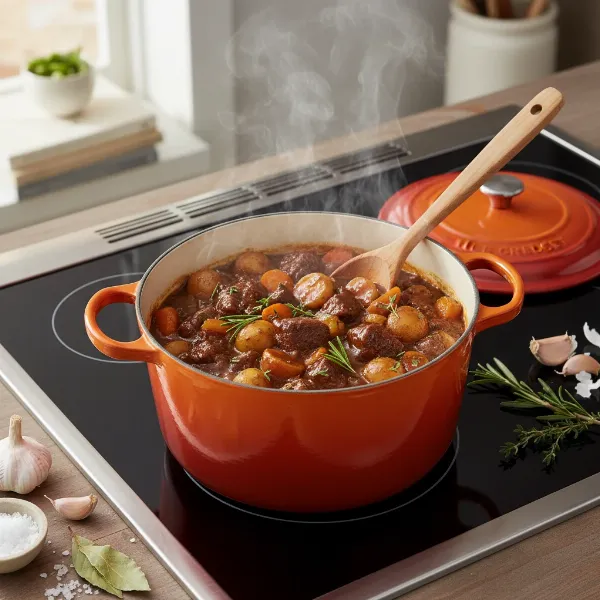 enameled cast iron Le Creuset Dutch oven simmering a stew on a stovetop
“Quality cookware, especially those crafted with care in traditional manufacturing hubs, can truly elevate your cooking experience and often lasts a lifetime.” – Admin, Crockpotz.com
Tips for Using and Maintaining Your Slow Cooker
To ensure your slow cooker performs optimally and lasts for years, follow these essential tips:
Safe & Effective Use
- Fill Correctly: Always fill your slow cooker at least halfway, but no more than two-thirds full, to ensure even cooking and prevent overflow.
- Browning First (Optional): While not strictly necessary for all recipes, browning meats and sautéing aromatics on a stovetop beforehand can add depth of flavor.
- Don’t Peek: Resist the urge to lift the lid frequently, as each peek releases heat and extends cooking time significantly.
- Food Safety: Always thaw frozen ingredients completely before placing them in the slow cooker to ensure even cooking and safe temperatures.
Cleaning & Care
- Cool Down: Allow the inner pot to cool completely before cleaning to prevent thermal shock, which can damage ceramic or stoneware.
- Hand Wash Recommended: While many ceramic inserts are dishwasher-safe, hand washing with a mild detergent and soft sponge can help prolong their lifespan and preserve any non-stick properties.
- Clean the Base: Wipe down the heating base with a damp cloth, ensuring it’s unplugged and completely dry before storage.
- Avoid Abrasives: Do not use abrasive cleaners or scouring pads, especially on non-stick surfaces, as these can cause damage.
Common Issues & Troubleshooting
- Food Not Cooking Through: Ensure the slow cooker is adequately filled and the lid fits snugly. Avoid frequently opening the lid.
- Too Much Liquid: Slow cookers retain moisture very well, so recipes may require less liquid than traditional stovetop cooking. Adjust accordingly.
- Hot Spots: While good slow cookers minimize this, occasionally rotating the insert if possible can help with extremely even cooking.
Where to Purchase Reputable Slow Cookers?
When seeking a high-quality slow cooker or multi-cooker from the USA or Europe, consider purchasing from:
- Official Brand Websites: Directly buying from the manufacturer ensures authenticity and access to their full warranty and customer support.
- Authorized Retailers: Reputable kitchenware stores, both online and brick-and-mortar, often carry a selection of premium brands. Look for stores known for their quality appliances.
- Specialty Cookware Shops: These stores often stock higher-end, niche brands that might be harder to find elsewhere, including traditional clay or cast iron options.
Always check product descriptions carefully for manufacturing origin claims and read customer reviews to ensure satisfaction and product longevity.
Conclusion
Choosing a slow cooker from manufacturers in the USA or Europe offers assurance of quality, craftsmanship, and often, innovative design. While traditional electric slow cookers predominantly come from Asia, excellent multi-cookers with robust slow cooking functions and traditional slow cooking pots from these regions provide superb alternatives. Whether you opt for the earthy goodness of a US-made clay pot, the cutting-edge technology of a German or French multi-cooker, or the timeless elegance of a French cast iron Dutch oven, investing in a well-made appliance promises years of effortless, delicious meals. What delectable dish will you create next in your European or American-made slow cooker?
Frequently Asked Questions
Are most slow cookers made in the USA or Europe?
No, the vast majority of slow cookers and kitchen appliances, even those from American or European brands, are manufactured in Asia, primarily China. Finding models with components and assembly entirely within the USA or Europe requires specific research into high-end multi-cookers or traditional cookware.
Why would I choose a slow cooker made in the USA or Europe?
Choosing a slow cooker from the USA or Europe often implies adherence to higher manufacturing standards, stricter environmental regulations, and potentially more ethical labor practices. These products may also feature superior materials, innovative design, and a longer lifespan, offering better long-term value.